Showing posts with label Judaism. Show all posts

Wednesday, October 3, 2018

Beautiful, Useful Things


            My father made beautiful, useful things with his hands and his tools. As far back as I can remember he had a well-equipped workshop in the garage which included a 1949 Shopsmith, an amazing multiple purpose woodworking tool that could saw, drill, sand, and best of all be a lathe on which he turned many intricate smooth objects like the posts and spindles on my brothers’ bunk beds, table legs, chair legs, candlesticks, and other decorative but useful items for our home.  I liked spending time with him while he worked, especially when he turned some blocky 4 x 4 post into a smoothly rounded, fluted, curving piece of beauty. I loved the smell of sawdust mingled with oil and the faint burning smell as his chisel cut into the swiftly turning block of wood.  I enjoyed the task of using fine sandpaper to further smooth the objects he turned on his lathe, luxuriating in the feel of the wood.

            After thirty years of knowing my father, I should have realized when I asked him drill 9 holes in a block of wood as a makeshift Chanukkiah* for my first Chanukah that he would not pay attention to my instructions, but instead create something incredibly beautiful that violated all traditional Jewish rules for a Chanukkiah.  A Baptist turned Methodist by marriage, my father knew nothing about my adopted religion. I think he wanted me to know that he supported me as I made this major change in my life, unlike my mother who took my conversion as a rejection of her and my childhood.

            I sent my dad (in California) a sketch of a plain, flat, block of wood with nine holes in a row. A few weeks later, I received (in Kentucky) a large box in return. Carefully wrapped in layers of tissue paper and newspaper was a work of art.

My first discovery was that he had chosen to use some of his precious chestnut wood instead of a scrap as I had suggested. The wood had been scavenged in the late 1970’s from his childhood home in Virginia. In the late 19th century before the blight destroyed most of the American chestnut trees, my grandfather had built the family home with chestnut paneling, stairs, railings, doors, molding, and other adornments.

Within the box was a block of wood, but unlike my sketch it had been carefully laminated in half inch layers of decreasing size, creating a double staircase effect with four steps on each side and a ninth platform at the top.  There were nine holes drilled, one in each step.  However, those holes were not for candles, for in the box, individually wrapped were nine perfect wooden cups, each with a stem to sit in the stair-stepped holes. Each cup had been turned separately on the lathe to perfect smoothness. They were all the same size, same diameter, same depth. The bottom of each cup had been curved like fat brandy snifters.  Each of those little wooden cups had to be turned on the lathe separately; checked and rechecked to make sure they were the same diameter, the same height, the same, length stem, so that when set in the stair-step block they would form a perfectly graduated holder for candles rising on both sides to a point in the middle.  I lifted each cup, turned them in my hands feeling the smoothness of the fine wood grain and placed them in the block one by one.


My father had carefully cut green felt and glued it to the bottom of the main block of wood, so that the bottom of it would not scratch or scar any surface it was place on. Then in the center of the bottom, he had left an opening in the felt, and in it he had burnt the words:  To SUE/from DAD/DEC 1981.
Thirty-seven Chanukahs have come and gone. Sometimes I consider getting a “proper” Chanukkiah. Jewish law and tradition say that all the candles in a Menorah or a Chanukkiah should be at the same height, because no day, and no person is more important than another. Also, Jewish law and tradition call for a new candles every night or a total of 44 candles, so most Chanukkiah are designed for small candles less than ¼ inch in diameter and only about 4 inches high. My father designed his candle holder for regular sized candle tapers - 2/3 of an inch in diameter and eight to ten inches in height. The cost of 44 regular sized candles is getting to be a little prohibitive these days even at Walmart.
But in the end, every year I use this cherished gift from my father. It may not meet the standards of Jewish law, but it is still beautiful and a product of love.
______________
*Most people refer to these as Menorahs. However, a Menorah is a seven branched candle stick used in synagogues and homes on the Sabbath. A Chanukkiah is a nine branched or holed candle holders used only for the eight days of Chanukah.

Friday, December 23, 2011

Anniversaries

This week we Jews celebrate an anniversary of a victory “of the weak over the strong, the few over the many, and the righteous over the arrogant.” (Gates of Prayer: The New Union Prayerbook, p. 642)


On the first night of this celebration we pray:

Blessed art thou, O Lord our G-d, Ruler of the Universe, who performed wondrous deeds for our ancestors in days of old, at this season.

and

Blessed art thou, O Lord our G-d, Ruler of the Universe, who gives us life, sustains us, and enables us to reach this season.

Then we light candles for eight nights in remembrance of this anniversary.

This Chanukkah also coincides with the 100th anniversary of my father’s birth (no longer his “birthday” as he died two years ago), and of significance to me, the thirtieth anniversary of my official conversion to Judaism. This means that starting now, I have been a Jew for more than half of my life.

I’d known that I wanted to be a Jew from the time I was about fifteen, but did not act upon that desire until I turned thirty. With my thirtieth birthday it seemed like it was time to make some changes, so I began studying with the Reform congregation’s Rabbi in Lexington, Kentucky in February 1981, attending services and becoming part of the Adaith Israel Congregation. In November 1981, I stood before the congregation during Shabbat evening services and spoke the words that made me officially bat Israel (daughter of Israel).

From a distance, in California, my father had shown in interest and expressed support in my transformation. So I asked him to make a Chanukkah menorah for me for my first official Jewish holiday observance. I drew a sketch of what I wanted, which involved simply drilling holes in a solid rectangular block of wood, a task that would be easy for my dad with his well equipped woodworking shop.

I made two mistakes. First, I asked for the holes to be sized to fit regular candles. Little did I know that proper Jewish observance requires fresh candles for each night of Chanukkah, and that adds up to 44 candles – and most Jewish families use Chanukkah menorahs sized for candles not much larger than those that go on a birthday cake. Second, I did not explain to my father that my little sketch of a block of wood with eight candles at the same height and only one elevated, was based on proper Jewish observance – only the shammus (servant) candle is traditionally at a different height.

My father, intent on doing an extra special job in creating this menorah for me, pulled out all his woodworking tricks. He built a graduated platform, and then with his lathe, turned individual wooden cups for each candle. He lined the bottom of it with green felt and burned the date into the base.

For thirty years, I’ve considered, replacing my father’s not very Jewish beautiful candelabra, with a small, more appropriately Jewish menorah. But I always end up rejecting the idea, and going out once again in search of 44 large candles to light my eight nights of Chanukkah.

Saturday, April 23, 2011

bulletins from the land of dementia

In many ways my mother seems to have regressed cognitively to her youth. She has lost decades of knowledge and understanding and reverted to ways of thinking that she deliberately chose to leave behind.

Today she was speaking of neighbors down the street, of a "different religion, not like us." Forgetting that I, her daughter, am "not like" her. Yet it is my mother who made me the person I am. It was her expression of religious doubt, her questions posed in my child's ear, her failure to blind acceptance of the religion in which she was raised, that made me the seeker that converted to Judaism.

My choice caused her some mild consternation at the time, but we talked it through and she was always supportive. Each spring she would mail me a care package of kosher for passover treats and boxes of Matzoh unavailable in the wilds of eastern Kentucky.

I accepted easily that her decline in the last few years meant she would no longer be sending me care packages (indeed now I'm the one sending stuff her way). But it did not occur to me until tonight's phone call, that she neither remembers nor understands the choice I made to be a Jew, why I made it, or what it means ("you mean you don't believe in Jesus at all?" she asked in bewilderment tonight); and that for her the hurt of my desertion is totally new and a fresh source of consternation.

Wednesday, December 23, 2009

the miracle of Chanukkah

Not to make light of my religious observances, but we had our own little Chanukkah miracle -- the Chanukkah candles that kept burning for four extra days.

The last night of Chanukkah was the night the snow storm started - the night all eight of the Chanukkah candles plus the shammus (which makes 9) are lit. My menorah is not a conventional Chanukkah menorah. First of all it does not conform to Halakhah (Jewish rules of observance and ritual). Halakhah requires that the eight candle holders for the eight nights all be the same height, no one more important than any of the others, and only the shammus, the candle used for lighting, is at a different height.

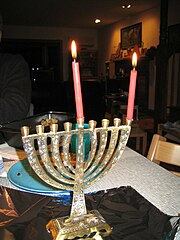
The year I converted (1981), for my first Chanukkah, I asked my father to create a simple menorah for me. I gave him instructions, but he did not understand that the instructions were based on Halakhah. He assumed that I was just trying to describe the simplest possible design. He wanted to do more for me. So he created the beautifully turned candle holder pictured below, which followed conventional western, (non-Jewish) ideas of design. I decided that love trumps Halakhah and have used that menorah every year since, despite its failure to conform to ritual rules.


The second way that my menorah is unconventional concerns the size of the candles it takes. Because Halakhah requires fresh candles for every night, most families' Menorahs are sized to take small candles, just slightly larger than those for birthday cakes. But in my instructions to my father, I asked for a menorah that would take regulation size tapers. That I have come to regret over the years since it takes 44 candles for all eight nights.

Since one uses fresh candles each night, I have quite a store of partially burned candles from year to year that I use for other things. At this point I had nearly 50 such candles that were more than 3 or 4 inches in length plus a few brand new, unused candles from this year (we forgot to light candles one night).

When the power went out, we just kept the menorah on the mantel filled it with previously used Chanukkah candles and kept the family room alive with warm light. Not enough to read by -- for that we had our LED headlamps -- but it made everything seem cozy and added warmth literally as well as figuratively for the duration of the power outage.

P.S. Note the really intriguing way in which the wax from the center candle (which is not lit) is drawn towards the flame of the lower candle.

Saturday, September 19, 2009

Rosh Hashanah

"HAYOM HARAT OLAM: Today is the birthday of the world." So it declares during the shofar (rams horn trumpet) service on Rosh Hashanah.

There are many themes twining through Rosh Hashanah. One important theme, as one might expect for the "birthday of the world" is creation. But the High Holidays Makhzor* reminds us:
"Creation, we are taught is not an act that happened once upon a time, once and for ever. The act of bringing the world into existence is a continuous process. God called the world into being, and that call goes on. There is this present moment because God is present. Every instant is an act of creation. A moment is not a terminal but a flash, a signal of Beginning. Time is a perpetual innovation, a synonym for continuous creation. Time is God's gift to the world of space."(page 329)
The Makhzor also tells us:
"Moreover, our Sages taught, the human being is "God's partner in the work of Creation." He and we create together. There is still much work to be done: disease to be conquered, injustice and poverty to be overcome, hatred and war to be eliminated. There is truth to be discovered, beauty to be fashioned, freedom to be achieved, peace and righteousness to be established. There is a great need to dedicate all the creative power which a creating God has given us, so that we may join Him in 'the continuing work or Creation.'" (page 149)
So Rosh Hashanah is a day to rededicate ourselves to being co-creators of the Universe, partners with G-d.

*Makhzor is a transliteration into English of the Hebrew word used for the book which contains the order of service, all the prayers, songs, poems (psalms), and teachings for Jewish services. The Makhzor used by my congregation, B'nai Sholom, is Makhzor Khadash/The New Makhzor for Rosh Hashanah and Yom Kippur, complied and edited by Rabbi Sidney Greenberg and Rabbi Jonathan D. Levine, The Prayer Book Press of Media Judaica, Inc. 1978.

Sunday, December 21, 2008

One Single Impression -- A Winter's Day

Today is the beginning of winter, the winter solstice, shortest, darkest day of the year in the northern Hemisphere. This evening at sunset is also the beginning of Chanukah, the Jewish festival of lights.
"The lights of Chanukah are a symbol of our joy, in time of darkness, our ancestors had the courage to struggle for freedom: freedom to be themselves, freedom to worship in their own way. Theirs was a victory of the weak over the strong, the few over the many, and the righteous over the arrogant. It was a victory for all ages and all peoples." (Gates of Prayer: The New Union Prayerbook, Central Conference of American Rabbis)

against winter’s dark-
Baruch ata Adonai
-we light the first light

shehecheyanu-
light of triumph, light of life
-vekiyemanu

vehigianu-
in the cold, a sacred light,
-lazeman hazeh.

***

against the winter’s dark-
Blessed art thou, oh Lord
-we light the first light

who has given us life-
light of triumph, light of life,
-and has sustained us

and enabled us-
in the cold, a sacred light
-to reach this season.


Photo of first night Chanukah menorah from Wikipedia

For more poems on the theme "A Winter's Day" see One Single Impression.

Sunday, October 26, 2008

keeping the faith

A reminder, coming across the electrons:

From the Talmund
"Do not be daunted by the enormity of the world's grief. Do justly, now. Love mercy, now. Walk humbly, now. You are not obligated to complete the work, but neither are you free to abandon it."


Thanks to Brian at HummingBunny for the reminder.

Sunday, September 28, 2008

Elul 28, 5768

Had I not the assurance
that I would enjoy the goodness of the Lord
in the land of the living...
Look to the Lord;
be strong and of good courage!
O look to the Lord.
Psalms 27:13-14

Elul comes to an end with sunset tomorrow (Monday) and Rosh Hashanah begins. Rosh Hashanah is a day without work -- a joyful day, a new year beginning. I end my thoughts about t'shuva, repentance and atonement, about choosing a better path for the future, by contemplating the last two verses of Psalm 27:13-14.
Noticing my sins, examining my failings, experiencing the regret, rejecting those actions and resolving to avoid them, to do better in the future is difficult work. And it doesn't end today, or with Yom Kippur. It's an on-going task, that just becomes more salient for Jews at this time of the year. It would be an overwhelming impossible task "had I not the assurance that I would enjoy the goodness of the Lord in the land of the living." For that is what I think that verse, unfinished, hanging there in the air pregnant with possibility really means.

Judaism is not about finding eternal life (although certainly some ideas about life after death exist within Judaism), but rather Jews are focused seeking connection to G-d, to the divine, to the goodness the divine in this life. Judaism is about the sanctification of life here and now. Sin and wrongness dull our experience of the divine, so we must strive to reconnect and eliminate those things that tarnish that connection. So I will look to the Lord.

Friday, September 26, 2008

Elul 26, 5768

Do not subject me to the will of my foes,
for false witnesses and unjust accusers
have appeared against me.
Psalms 27:12


While this is not a story that I wish to go into detail at this time, in this forum, I was once denied tenure in large part due to "false witnesses and unjust accusers." Despicable lies were told and retold so often that despite any evidence to support them, they came to be believed by a number of people who were influential in recommending that I be denied tenure.

I spent many years being angry about the unjustness of this decision. I was particularly angry with one individual who knew full well that the accusations were lies, but had other reasons to want me gone, and used the lies to accomplish that.

For years, ten years to be exact, I allowed my anger with this one person to poison my life. Every year at the High Holy Days I would think about this and pray over it, and recognize that I needed to forgive this person and let go of my anger. But was unable to find a way. I knew that I needed to forgive the person who wronged me, but that I could not offer this person a simple "I forgive you." This would only anger and antagonize him, because he believed himself to be in the right and I in the wrong. To gain the repentance I needed to move on, I had to do something that was genunine and sincere, yet would not be taken as hostile or a put down, or showing off.

Finally two years ago, I found the right action to take, that would allow me to let go.

The fact was that being denied tenure was the best thing that could have happened to me. I left a college that had a poisonous atmosphere, and found a new college with a supportive culture. I left a college that talked about the importance of teaching but did not honor or reward it, and found a new college that genuinely focused on quality teaching. At my new college I had opportunities to write, to be creative, to learn entirely new forms of pedagogy that would never have come my way had I remained where I was.

So two years ago, I wrote a simple, genuine, heartfelt letter of thanks. This freed me from dwelling, over and over again on the injustice, and allowed me to face situations where he was likely to be present with equanimity, rather than avoid them. In fact, I had not thought about the whole situation for the past two years until reading today's verse brought it to mind.

The verse says "Do not subject me to the will of my foes." What I make of this, based on my own experience, is that G-d cannot make the false witnesses and unjust accusers disappear from our lives. G-d cannot prevent them from doing us certain kinds of harm. But turning to G-d and divine inspiration can free us from the corrosive affects of anger, resentment, fear and anxiety. It is the inner harm, the psychic, emotional and moral harm that our foes will upon us from which G-d can protect us.

Sunday, September 21, 2008

Elul 21, 5768

What constitutes t'shuvah? That sinners should abandon [their] sins and remove them from [their] thoughts, resolving in [their] hearts never to commit them again....One must verbally confess and state these matters which have been resolved in one's heart.
Moses Maimonides Laws of Repentance 2:2


The rabbis of ancient times had, as mentioned before, many different views about both faith and practice. Different teachers and sages offered up different approaches or systems for repentance. The one thing that all of them shared was that they viewed t'shuvah as a process that takes place is stages or steps. As I read and learn more this season of Elul about t'shuvah, I am struck by the similarities between the ideas of my chosen faith and those of twelve step programs like AA.

Judaism does not treat addictive behaviors like smoking, drinking, substance abuse, as sins in the same way that some other religions do -- focusing more on the damage we do to others than on that we do to ourselves. But there is a strong connection in Judaism between the process necessary for ridding ourselves of self-destructive addictive behaviors and stopping the sinful behaviors (such as those listed on Elul 18) which may also arise from deeply ingrained unconscious motives such as fear.

Verbal confession and verbal commitment are emphasized in twelve-step programs, and emphasized in Jewish texts on t'shuvah. Saying things out loud, even when we are our only audience gives power to our resolutions.

So I resolve and state for myself that I will work to pay attention and try to recognize and understand where the fear, panic or impatience is coming from before I open my mouth to say something harsh and hurtful, before I shoot off that e-mail with ALL CAPS, that will hurt someone.

Friday, September 19, 2008

Elul 19, 5768

Do not hide Your face from me;
do not thrust aside Your servant in anger;
You have ever been my help.
Do not forsake me, do not abandon me,
O God, my deliverer.
Though my father and mother abandon me,
the Lord will take me in.
Psalms 27:9-10


I sit in the quiet of my study, looking out on our neat green lawn shaded by huge maples and sycamore, the late afternoon sun hides behind the trees casting shadow across the yard. But it is not the sun that hides from me, any more than it is G-d that hides from us. Both the sun and G-d are there, hidden by the things that get between us.

It is easy to sit here, my work done for the evening, no children demanding my attention, my husband and dog out for their evening walk, and write about faith and practice. But most of the time life is not like that, most of the time the forest of our responsibilities to family and work, and the thicket of modern distractions (television, Internet) plunge us into shadow where the divine is hidden from us.

Human beings are often faithless and desert us, as the Psalm says even our father and mother may abandon us. It is hard for us to imagine that there is a force, a presence in the universe that is more constant, that is always there to be sought out.

It's easy for me to recognize the divine spark in the world as I drive to and from work -- looking out over our deeply wooded hills. It's the hours in between during which I have problems, and yet when I most need to be mindful of the divinity, to see past the shadows and the trees.

My most frequent sins, are the sins of impatience and intolerance with people who don't "get" things as quickly as I think they ought, who don't listen and don't read, and don't pay attention, who hold a piece of paper with big bold print that says "this test is due on..." and ask me "when is this test due?" This is really bad in a teacher. It is a form of arrogance and pridefulness. I have achieved the first stage of t'shuva -- I recognize these sins and regret them. I haven't yet found the way to successful break this habitual sins. I need to find a better way to interject a moment of reflection between the thought and the heedless action (the sharp tongue, the harsh tone).

Thursday, September 18, 2008

Elul 18, 5768

There are sins that can be atoned for immediately and other sins which can only be atoned for over the course of time.
Moses Maimonides, Laws of Repentance 1:4

There are many levels of repentance through which one draws near to the Holy Blessed One. And although there is forgiveness in relation to each kind of repentance, the soul does not become completely purified...unless one purifies one's heart and properly conditions one's spirit.
Rabi Jonah of Gerona (1200-1263) Gates of Repentance, The First Gate


I decided that I wanted to become a Jew when I was 15, but did not act upon that decision until I was 30,twenty seven years ago. Shortly after I turned 30 I began studying with Rabbi Leffler of the Reform Congregation in Lexington, Kentucky. Those weekly conversations we had made an indelible mark on my life and my soul. In one of those conversations Rabbi Leffler drew a diagram on the chalk board that sat in his office, like the one to the right. He said that some religions place their emphasis on the leg of the triangle between "me" and "G-d" with the idea that if one "gets right with" G-d through faith and prayer, that relationships with others will fall into place. But, Rabbi Leffler said, Judaism places its emphasis on the base of the triangle, the connection between "me" and "others," and that by working on our relationships to others, through following the mitzvot, that through building those relationships we will build our relationship with G-d.

So what does that have to do with the passages from the medieval Jewish thinkers (above) about repentance and atonement (t'shuva)? The vast majority of sins for which Jews must repent and atone are sins against others. I have mentioned previously the beautiful Ashamnu ("We have trespassed") prayer of Yom Kippur. Here are some of the sins listed: "we have dealt treacherously; we have robbed; we have spoken slander; we have acted perversely...we have done violence; we have practiced deceit; we have counseled evil; we have spoken falsehood...we have oppressed...we have dealt corruptly...we have led others astray." These, the majority of the sins in the prayer deal with acts against our fellow humans, not acts against G-d.

For the sins we have committed against G-d (such as blasphemy), our regret, rejection and resolution to sin no more can bring immediate repentance and forgiveness. But our sins against others often require us to perform acts of atonement, of restitution and restoration; not unlike in 12 step programs (Alcoholics Anonymous for example) where in order to change the individual must make amends to those they have wronged (unless to do so would bring further harm). Repentance and forgiveness can only come over time, as we work on our relationships with others.

Tuesday, September 16, 2008

Elul 16, 5768

Hear, O Lord, when I cry aloud;
have mercy on me, answer me.
In your behalf my heart says:
"Seek my face!"
O Lord, I seek your face."
Psalms 27:7-8.


In Judaism some prayers, such as the Shema, should always be uttered aloud, and other prayer is silent, internal, like the silent Amidah in services. It is not for G-d's ears that prayer is aloud, but our own -- it focuses our own attention on our words, our plea, on our reaching out to touch the source of power, the divine.

One of the traditions of Judaism is that in the beginning G-d created the universe as a material container into which divine light and spirit were poured; but the material container could not contain the G-d's infinite divinity, and ruptured in a great cataclysm, creating the dispersed universe of space and matter that we know. But G-d's light and divinity clung to the shattered shards of the universe. Every molecule, every bit of matter in the Universe (including living beings) carry within the spark of divinity.

Our prayer goes out through that spark of the divine within us, and the answer comes back to us from that spark within. Notice how the Psalm says "In your behalf my heart says..." G-d speaks to us through our own heart, and through the hearts of others that carry that divine spark.

I think that there is no question that G-d hears us and has answers for us. What is questionable is whether or not we can hear that response that vibrates in all of nature, in all the people around us, and in ourselves. We seek G-d's face, yet it is all around us, just waiting to be recognized. Prayer is an opportunity to draw upon the power of the divine that will help us see and recognize G-d's face in all it's manifestations.

Sunday, September 14, 2008

Elul 14, 5768

Now is my head high
over my enemies roundabout;
I sacrifice in His tent with shouts of joy,
singing and chanting a hymn to the Lord.
Psalm 27:6

Today's verse from Psalm 27 reminds me immediately of one of my favorite books -- not just in childhood -- Pollyanna. Pollyanna's father (dead before the story begins) was a minister who emphasized the "rejoicing texts" of the Bible -- the ones that say "shout for joy," "rejoice greatly," "be glad in the Lord, " and so forth. Pollyanna tells the local minister (a troubled man) that once when feeling low her father counted all the rejoicing texts and found more than eight hundred of them. Pollyanna's recounts that her father said "if God took the trouble to tell us eight hundred times to be glad and rejoice, He must want us to do it -- some."

The book Pollyanna was first published in 1912. In the decades that followed through the first World War and the great depression, the book continued to be extraordinarily popular with both adults and children. However, the word "pollyanna" came to be used by many during those decades as an pejorative label to describe someone who was blind to reality, living in an impossible dream world in which every thing had a silver lining.

Nonetheless, I still find this book whose charming heroine unself-consciously transforms those around her through her postive outlook to be refreshing and inspiring.

And I will sing and chant a hymn to the Lord.

Friday, September 12, 2008

Elul 12, 5768

"He will shelter me in His pavilion
on an evil day,
grant me the protection of His tent,
raise me high upon a rock."
Psalm 27:5

Judaism is a religion that allows for a wide range of personal interpretations of Torah and G-d. Indeed alternative interpretations are enshrined in the Jewish tradition through the Talmud and Mishnah, which record and pass down the debates of Rabbi's and scholars through the ages. Every issues is discussed and argued, and all the points of view are recorded for Jewish posterity. In Judaism "orthodoxy" is not orthodox belief but orthodox practice.

In my personal view, G-d initiated a universe designed to evolve and give rise ultimately to creatures of self-awareness, self-consciousness and free will (we humans being the only example of which we are currently aware, but that does not preclude others else where in G-d's universe). Such a G-d in such a universe does not intervene in the unfolding of events that result from the choices of free-will. But for those willing to open their hearts and minds, willing to reach out to the divine power of the universe, G-d provides shelter in which we can rest from the storm, gaining strength and courage. The divine power of the universe is found in the principles of nature, including basic principles that underlie human interactions, seeking that power and those principles, is seeking the rock or foundation on which the world stands.

In my personal view there is more than one path to achieve this shelter and find this rock. For me the path is through the Jewish scriptures and traditional practices and prayers. But I see my husband finding the same thing in a different way through the Buddhist scriptures and the practice of Buddhist meditation. He also finds the sheltering tent and the rock on which all is built.

Thursday, September 11, 2008

Elul 11, 5768

"Who has achieved complete t'shuvah? A person who confronts the same situation in which he sinned and abstains, although that person has the potential to commit the sin again."
Moses Maimonides, Laws of Repentance 2:11


The word that comes to my mind as I read this prompt for contemplation is "persistence." T'shuvah requires more than acknowledgement and repentance, it requires persistence in making changes. However, I am struck by the thought that change to a life lived fully in G-d's house, in harmony with G-d, is about just as much about developing positive actions and habits as it is about ending negative actions.

This view about nurturing positive habits is very central to Judaism. Of the 613 mitzvot of the Torah nearly a third are affirmative commandments: "To know G-d exists;" "To love G-d;" "To honor the old and the wise;" "To learn Torah and to teach it;" "To affix the mezuzah to the doorposts and gates of your house;" "To read the Shema in the morning and at night;" "To leave the gleanings for the poor;" "To give charity according to one's means;" "To love the stranger;" "To honor father and mother," and many, many more.

Persistence means coming back again after a slip or a lapse; not using the lapse as an excuse to say, oh well, I messed up I may as well not bother. This is one of my failings. It is easier to keep commitments to change when we involve others in our decisions and activities -- even if the others are just out there on the Internet.

I missed yesterday, Elul 10, the workload piled up, and I did not take time for contemplation, prayer and writing. In my past tries at this practice missing a day inevitably meant stopping altogether. But I made a commitment to a larger audience (even if you are a small one) as well as a commitment to myself. So persist I will.

Involving others to help us persist, is one reason why Jews engage in group repentance at Yom Kippur. We all, communally and publicly admit to the entire range of human sins and promise to make amends and change in the coming year. The confessional prayer Ashamnu, in my Conservative/Reform synagogue is recited in both English and Hebrew. I prefer the Hebrew, it is both beautiful and solemn and intensely meaningful. The cantor sings the first line (Ashamnu or "We have trespassed") and the congregation sings the same line back; and then the pattern repeats, cantor then congregation through the entire litany of sins.

So in this coming new year I seek persistence, to return when I stumble to the path of persistence in both the affirmative actions and avoidance of negative actions.

Tuesday, September 9, 2008

Elul 9, 5768

One thing I ask of the Lord
only that do I seek;
to live in the house of the Lord
all the days of my life,
to gaze upon the beauty of the Lord,
to frequent His temple.
Psalm 27:4


The amazing thing is that this wish has already been granted for all of us, for the universe is the house of the Lord, the temple of G-d; the plants, animals and people the inhabitants of that house. All we need do is open our eyes, our ears and our hearts to sense G-d all around us.

The problem is that so much of the time, the business of daily life, the buzz of work, school, chores, shopping, daily worries, fills our senses and hearts and blocks our awareness.

I feel lucky that I live in the country, where the world is still and green, and it is easier to sense the divine. But some times listening is scary, because it makes me aware of how far I need to go to be the kind of person I really want to be. So its easier many days to just turn on the TV and bury the senses in white noise. This year I resolve to spend more time just being in the world, to stretch out my senses for that touch from G-d.

Monday, September 8, 2008

Elul 8, 5768

The high holy days of Rosh Hashanah and Yom Kippur are about T'shuvah -- repentence -- with the attendant promise of renewal and return that true repentance promises.

The medieval philosopher Moses Maimonides wrote that there are three stages of t'shuvah: regret, rejection, and resolution. Today's meditation prompt is from Maimonides' Laws of Repentence 1:1.
"How does one acknowledge sin? One says: I implore you G-d..., Behold, I regret [what I did] and am embarrassed by my deeds. I promise never to repeat this act again."

This does not refer to being embarrassed in front of people -- whether one's family, one's friends, one's coworker -- but embarrassed before God, and before our own inner spark of the divine.
To be embarrassed on has to be aware, to be conscious, to notice error when it occurs. One has to own one's faults.

I have frequently found that it is easier to recognize my past faults, my sins of years gone by, than it is to recognize those of the present moment. But I have been working on this.

Less than rational fears--fears of someone else gaining control over me or my work, of someone else exerting dominance or taking away my ability to make decision, provoke me at times to retaliate or even make preemptive attacks with criticism and complaints.

I am noticing that I am becoming embarrassed (in the sense Maimonides meant) more often and more quickly. Sometimes quickly enough to stay actions that I will regret, but not always. Not always quickly enough to prevent me from sending that rude or critical e-mail, or prevent me from making the hurtful retort, but at least to acknowledge, admit my fault and make amends when possible instead of hanging on (sometimes for years) to my self-justifications and rationalizations.

I read in a blog recently about one family's tradition of "the groundhog" do-over. They got the idea from the movie "Groundhog Day." In this family, when there is something that goes wrong, when someone does something that is unacceptable or offends other family members, and they immediate proclaim a "groundhog" and start over, and do it right. Say, that mom is tired at the end of the work day, and when son comes into the kitchen to inquire about dinner she snaps at him impatiently. Rather than allowing him to slink off hurt, and her to simmer, then regret later what she said, she immediately announces a "groundhog" and has her son replay his entry into the kitchen. Then she greets him the way she feels she should have in the first place. This family discovered that after a while, it became less and less necessary to declare a "groundhog" because they learned to think before speaking and acting and not do or say things that needed amends.

I tried doing a "groundhog" once with my husband, but it seemed awkward and forced -- and I think John thought I was nuts. So instead I'm trying to apply the general principle instead of literally using the technique -- which I think is recognizing and confronting when one has erred, and making amends as soon as possible. I have a long way to go, but I think I'm on the road...

Sunday, September 7, 2008

Elul 7, 5768

The last month of the Hebrew year 5768 is Elul, and today is the seventh day of the month of Elul. Spiritually Elul is significant because it leads up to the holiest moments of the Jewish year, Rosh Hashanah (New Years) on the first of Tishrei and Yom Kippur (Day of Atonement) on the tenth of Tishrei.

Eleven years ago I purchased a guided journal for meditation and reflection during Elul and the first ten days of Tishrei. I've begun that journal three times in the past 11 years, generally running out of steam after 7 to 10 days into the project. This year, I'm going to try to work through the project, using my blog.
In Judaism faith and practices are inextricably intertwined. One important expression of that in Judaism is tikkun olam -- the obligation to engage in repairing the world, making it a better place. Faith and practices are mutually reinforcing, through practice we renew faith.

There are many kinds of practice, some focused inwardly heshbon hanefesh to make an accounting of the soul and prepare us for the outward practice. It is this type of practice we focus on in Elul.

During Elul it is traditional to recite and consider Psalm 27.

The Lord is my light and my help;
whom should I fear?
The Lord is the stronghold of my life,
whom should I dread?
Psalm 27:1
note: all quotes are from the TANAK translated and published by The Jewish Publication Society in 1999 (5759).

My greatest failing and weakness in life is allowing myself to be governed by fear --fear of others, fear of loss of control, fear of fear itself. (See poem in previous post). My fear of being controlled by others, often leads me into hostile and manipulative behaviors. The paradox is that when I act this way, I am not acting freely, but rather am being controlled by my fear.

I foolishly thought that once I got tenure and had security in my livelihood that my fear reactions would subside. But fear had become a habit, a habit that I need to work to eradicate.